The Water Butt Knows: Notes from the Allotment Fence
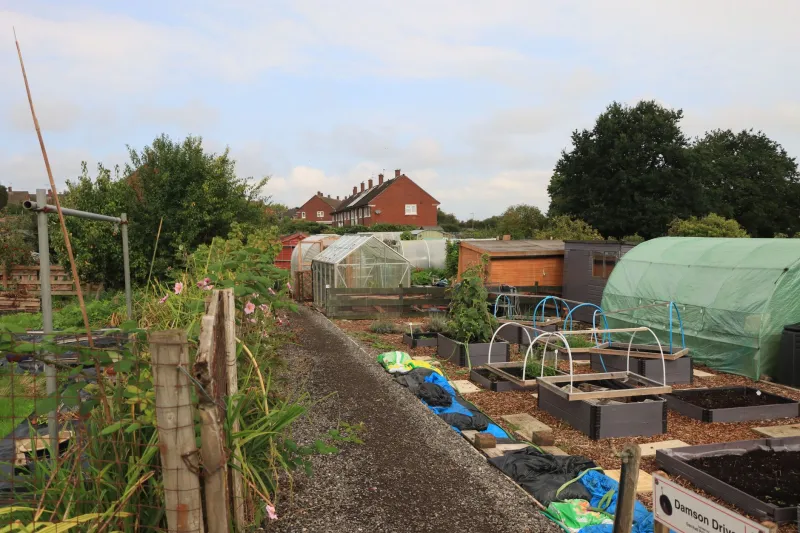
There is a particular silence on an allotment site at seven on a Sunday morning. It is not the silence of nature. It is the silence of several dozen people pretending not to watch each other through net curtains and shed windows. A gate clicks. A kettle flicks on. Somewhere, a man in a fleece examines a neighbouring row of onions as if they were a used car. The allotment is awake.
The First Rule of Plot Club
Nobody tells you the rules. That is the first rule. You are handed a key, a patch of couch grass and a vague sense that you have joined something. Then you spend the next three years learning the constitution by osmosis and minor humiliation. The allotment is not a hobby. It is a small, self-governing country with an unwritten planning code, a foreign policy and a deeply felt sense of history.
The committee exists, of course, but its power is mostly atmospheric. It lives in laminated notices, in the tone of an email about the communal skip, in the way someone says 'we usually keep that path clear' while holding a strimmer. You do not argue with the committee. You nod, you clear the path, and you add it to the mental list of things you will quietly resent until Bonfire Night.
Water Butt Realpolitik
The communal water butt is where the whole system reveals itself. On paper it is a plastic tank. In practice it is a shared bank account, a diplomatic channel and a test of character. You may fill your can. You may not drain the butt. You may not leave the tap running while you discuss the weather with a neighbour, because the person behind you in the invisible queue has been waiting since April and has opinions about waste.
There is a hierarchy to watering. The person who installed the butt speaks about it with the quiet authority of a founder. The person who repaired the downpipe is a statesman. The person who once left the tap dribbling overnight is still, years later, discussed in the past tense. Nobody will say it directly. That would be rude. Instead, a small sign appears: 'Please turn tap off fully. Thank you.' The 'thank you' is doing a lot of work. It is the velvet glove around a very damp fist.
The Long Leek Cold War
Then there are the leeks. Or the onions, the marrows, the giant parsnips, the single perfect cauliflower that looks as if it has been ironed. The allotment is not a competitive sport in any official sense, unless you count the village show, and everyone counts the village show. But even without a rosette, there is a silent scoreboard. It hangs in the air between two plots like a washing line.
You do not say 'my leeks are bigger than yours.' You say 'you've done well with those.' The reply is always 'oh, they're nothing special.' This is not modesty. It is a tactical withdrawal. The moment you admit your leeks are good, you invite scrutiny. Someone will ask what you fed them. Someone else will remember that you were seen buying manure in bulk. The cold war is fought with compliments, seed catalogues and the strategic deployment of a bucket.
Shed Doors and the Archaeology of Grudges
A shed is not a building. It is a diplomatic mission. The inside tells you everything: the kettle, the radio, the calendar from a seed merchant, the jar of screws that has outlived three governments. The outside is where the messages live. A handwritten note taped to a door can carry more weight than a council letter. 'Please do not borrow tools without asking.' 'Can whoever took the wheelbarrow return it.' 'Thank you.' That final 'thank you' again. Britain's entire social contract in three words and a biro.
Grudges are archived with care. The person who borrowed a spade in 2019 and returned it with mud on the handle is not forgotten. The person who parked across the gate during the compost delivery is remembered at every compost delivery thereafter. Allotment memory is long because the plots are small. There is nowhere to put the grudge except in the shed, next to the twine.
The Gift Economy of Gluts
And yet the same site runs on extraordinary generosity. Courgettes appear on benches. Bags of runner beans sit by the gate with no note. Rhubarb is forced on strangers with the enthusiasm of a religious conversion. The glut is a social contract: you accept the marrow, you accept the debt. Next year, when your own crop explodes, you will repay it in bags of beans and a slightly apologetic shrug.
This is the part that outsiders miss. The allotment is not really about self-sufficiency. It is about being known. It is about someone noticing that your tomatoes have blight before you do, and leaving a note. It is about the person who waters your greenhouse when you are away, and the person who definitely does not, and the fact that you will never be entirely sure which is which.
What the Plot Actually Grows
In 2026, with waiting lists longer than some council tenancies and the price of a decent tomato somehow still rising, the allotment has become a curious recommendation as much as a practical one. Walk past a site on a summer evening. Do not stare. Listen to the clink of a watering can, the murmur of a radio, the decisive click of a shed padlock. What you are hearing is a living archive of local personality. It is also a masterclass in passive aggression, conducted in whispers, notes and the careful placement of a water butt.
The water butt knows who watered the tomatoes. It says nothing. That is the point.