Salt, Vinegar and the Order of Things: What the Chip Shop Queue Still Teaches Us
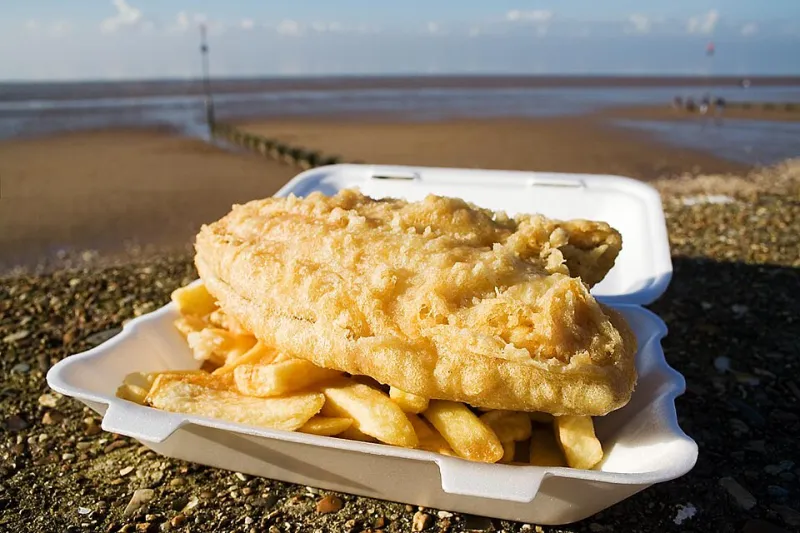
Photo: Andrew Dunn, CC BY-SA 2.0, via Wikimedia Commons
Twenty to seven on a Friday, and there are nine of us in a room the size of a generous van. Nobody is talking. This is not coldness. This is protocol.
The chip shop queue is the last piece of civic infrastructure in Britain that runs entirely on consent. No ticket machine. No barrier. There is a laminated sign — PLEASE BE PATIENT, WE COOK TO ORDER — but it is not enforcing anything. The queue enforces itself, and it does so with a precision that would embarrass a supermarket self-checkout.
Nobody is in charge, and yet
Watch a chippy queue form and you are watching something quietly astonishing: a group of strangers agreeing, without discussion, on a single shared fact. Who was here first.
That is it. That is the whole social contract, and it is load-bearing. Everything downstream depends on it — the order of the fryer, the fairness of the wait, the willingness of a tired person to stand for eleven minutes in a coat that smells of rain and old oil. Break the fact and the room does not erupt. It goes politely glacial, which is worse.
Compare it with almost anywhere else. At a bar, the elbows come out. At a bus stop, we pretend the queue is a fiction and then get quietly furious when it is treated as one. Only at the chippy do we still believe in first-come, first-served with the conviction of a people who invented the thing.
A rough taxonomy of the queue
The Lone Cod. One person, one order, one bag. Moves fast, speaks in shorthand — “cod and chips, salt and vinegar, mushy peas” — and is out of the door before the change hits the counter. The Lone Cod is the queue's metronome. Be a Lone Cod when you can.
The Family Bloc. Four to six people, one of whom is doing all the ordering and two of whom are outside with a dog. Occupies floor space like a furniture delivery. Legitimate, but slow, and the queue knows it, and the queue forgives it, and the queue would appreciate it being done briskly.
The Late Joiner. Arrived after you, but “was already here” — technically in the car, or in spirit, or holding a bag from the Co-op. The unwritten rule is generous but not infinite: one person may hold a place for one other. Two is a stretch. Three is a coup.
The Counter Philosopher. Reaches the front, then begins negotiations. Is the haddock nice? Is the batter soft or crisp today? Could they do a small chips but in a large box? Behind them, ten people stare at the vinegar bottles with the intensity of a hostage video.
The Person Who Remembers Something. Gets to the till, pays, then adds a pickled egg. Or a can. Or, catastrophically, “oh — and a sausage for the dog.” We have all been this person. We should all stop.
The extended order and other acts of God
Then there is the true test: the order that stops time.
Six cod, four battered sausages, two pies, one no batter at all, one gluten-free, three regular chips, one large, extra scraps, curry sauce on the side, and please could the pie be the steak one not the mince one. It is delivered from memory, at speed, by someone who has clearly been nominated for the job and is regretting it. The person at the fryer takes it all in, nods, and does not write a single word down.
That is the miracle, incidentally. Not the queue — the memory. Twenty-plus items, no paper, no mistakes, no fuss. If anything in this country deserves a blue plaque it is the woman in the tabard who can hold a family's entire Friday in her head while three pans spit at once.
The extended order is not the queue's enemy. It is the queue's reason for existing. Everything else — the park, the play area, the bath running upstairs — hangs off this bag of hot paper. So do it well, do it once, and do it in one go.
A short, mildly bossy guide to queueing properly in 2026
- Decide before you arrive. Not at the door, not at the counter. Standing there reading the menu like it is a lease is the one behaviour that unites the entire room against you.
- Say the whole order once. No additions. No recalibrations. If you must, add them at the very end, with an apology, and accept your place in the moral order of things.
- Do not sigh at the fryer. The chips are not ready because chips are never ready. That is the entire premise. Waiting for the fryer is the chippy's version of the Shipping Forecast: it is not for you, it is for everyone.
- Card is fine now, and stop banging on about cash. Yes, some shops prefer it. Read the room, read the sign, use what is wanted.
- Step aside when you have paid. The bit of counter between the till and the door is a working area. Standing there re-counting your change is like parking on a dropped kerb.
- Thank the people behind you. Not the staff — them as well, obviously — but the two or three souls who let you hold your place. A nod will do.
Why it still holds
There is a lot of talk about what has been lost from British high streets: the banks, the butchers, the strange little shops selling only picture frames. And it is all true. But we still have this, and it still works.
A queue is an agreement that other people's time is as real as your own. That is not a small thing to ask of a country in 2026. We manage it, most Fridays, in a hot little room that smells of vinegar and old newspapers, and nobody has to enforce a thing.
Then someone's phone goes and they shout “I'm in the queue!” down it, and the whole fragile edifice shudders. But it holds. It always holds.
Now order, please. There's a haddock coming out.