Please Sit Down: In Praise of the Town Centre Bench
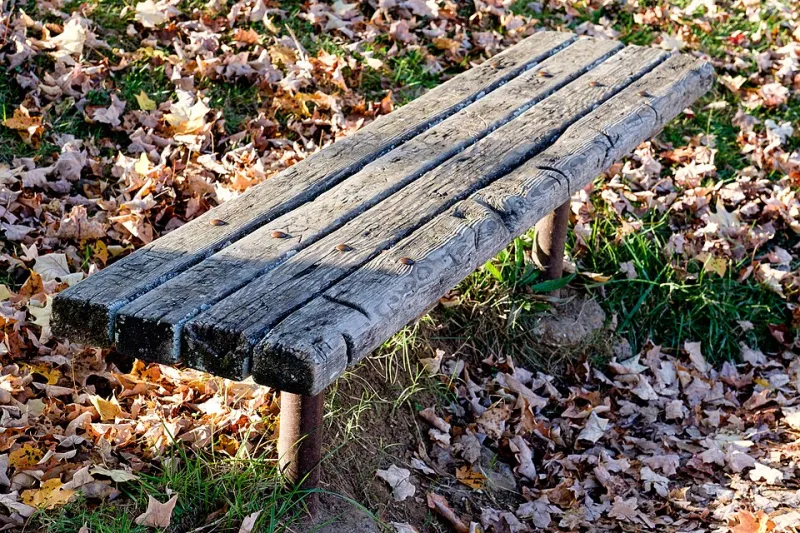
Photo: David Ratledge, CC BY 4.0, via Wikimedia Commons
The bench is a small civic miracle
I have a favourite bench. It is not grand. It faces a bus stop, a bin and a branch of a pharmacy that has changed its name three times since I started sitting there. But it has a plaque, a view of the church tower and just enough slats left to suggest that somebody, somewhere, once cared. That is the municipal bench in a nutshell: a small, cheap, unglamorous piece of public luxury. In 2026, when councils are juggling budgets and every public space seems to be either sponsored or fenced off, the bench remains one of the last bits of civic life you can use without buying anything. You do not need an app. You do not need a membership. You just need to sit down.
Memorial plaques and the micro-local story
The best benches have plaques. Not the corporate ones thanking a sponsorship deal in letters so small you need a magnifying glass, but the brass ones screwed in by families. A plaque saying 'In memory of Elsie, who loved this view' tells you more about a town than a heritage board. It says someone walked here, sat here, fed pigeons, complained about the bypass. Benches are a form of unofficial local history. There is the bench outside the surgery where every retired man in town gathers at 9am to discuss the weather as if it were breaking news. There is the bench by the war memorial that teenagers use as a meeting point and pensioners use as a resting point, sometimes at the same time, with an unspoken treaty about who gets the armrest. These are not trivial things. They are the furniture of belonging.
People-watching etiquette
Using a bench well is a social skill. The rules are unwritten but firm. Leave a slat's width between you and a stranger if there is room. If you must share, nod once and then look at something else. Do not comment on their shopping. Do not lean over to read their newspaper. If someone is eating a sandwich, give them the dignity of pretending you have not noticed. The bench is a place for parallel solitude, not forced friendship. That said, the best bench conversations happen when neither person started one. A dog arrives. A bus is late. Someone says the council has let the flowerbed go. Ten minutes later you know the name of their sister and their opinion on the new pedestrian crossing. This is the high street's best free theatre.
The quiet scandal of neglect
Here is the polemic. We treat benches as if they maintain themselves. They do not. Wood rots. Paint flakes. Slats vanish. A bench gets removed for 'health and safety' and never replaced. A new bench appears with a tiny plaque thanking a sponsorship deal, and it is bolted to the ground at an angle that makes it impossible to sit on without sliding off. We spend millions on planters and wayfinding and public art that looks like a dropped cutlery drawer, then act surprised when people do not linger in town centres. Of course they do not linger. There is nowhere to put their backside. A bench is not a luxury. It is infrastructure for old knees, tired parents, people waiting for a lift, people who need to sit down before they cry, and anyone who has just walked further than they meant to.
How to audit your own town's benches
This is easy and oddly satisfying. Take a notebook, or the notes app on your phone, and spend an hour being a bench inspector.
- Count them. Start at the bus station and walk the main shopping street. How many are usable? How many are just ornamental?
- Test the sit. Is the seat height right? Does it slope? Is there a backrest? Can you get up again without making a noise like a folding deckchair?
- Check the shade. A bench in full sun is a punishment in July. A bench under a tree is a public service.
- Look at the plaque. Photograph it. Note the names. This is local history hiding in plain sight.
- Note what is missing. Bins, backrests, armrests, a bit of pavement wide enough for a wheelchair or pram.
- Ask who uses it. Watch for ten minutes. You will learn more than any consultation survey.
Then send a short, polite email to the council or your local councillor. Not a rant. A list. Councils respond better to lists.
Three benches with unexpectedly good views
You do not need a national park. Some of the best views are municipal.
- The bench at the top of a multi-storey car park. Yes, really. Rooftops, church spires, a distant hill. It is like a free observation deck with a smell of diesel.
- A canal towpath bench just outside town. Water, geese, a distant gasometer. The gasometer is doing more for the skyline than any sculpture.
- A cemetery bench. The best trees in town, no one hurries you, and the view is always improving.
But the real recommendation is this: find the bench that looks at something ordinary — a depot, a bridge, a bowling green — and sit there for ten minutes. The view improves. That is the thing about benches. They teach you to look at what is already there.
Sitting is a civic act
Every time you sit on a town centre bench, you are voting for a certain kind of Britain. One where public space is not just a route from car park to shop. One where you can pause without spending. So sit. Wipe the slats with a tissue. Read the plaque. Nod at the person on the other end. And if the bench is broken, say so. In 2026 we need fewer grand gestures and more places to rest our legs. The bench is a small thing. That is exactly why it matters.