The Padded Coat and the Plastic Santa: Reading Your Town at the Christmas Lights Switch-On
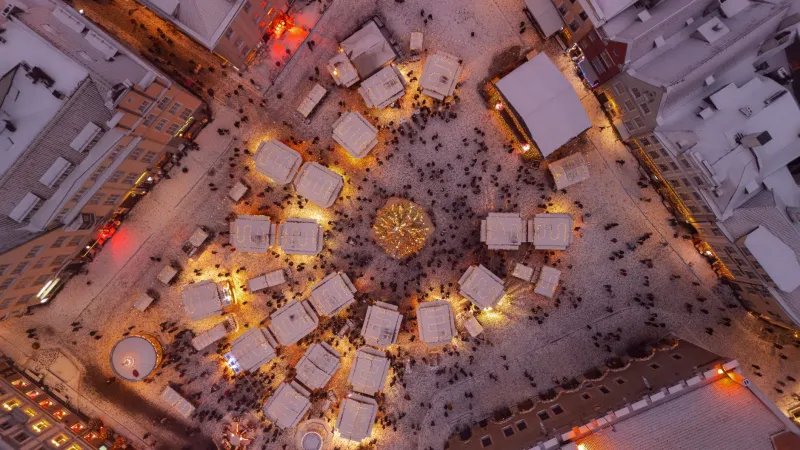
Every town has its own version of the same evening. It happens in late November, usually on a Tuesday, because Tuesday is what the council can afford. The square smells of damp tarmac and fried onions. A school choir is arranged in a semicircle near the war memorial, wearing hi-vis tabards over their coats. Someone is testing a microphone by saying 'hello, hello, one two' with the weary authority of a person who has done this since the millennium. Then the local radio presenter in the padded coat arrives, and the countdown begins.
This is not really entertainment. It is a public audit.
The Civic Health Check Nobody Printed on the Leaflet
A Christmas lights switch-on tells you more about a town than any regeneration consultation. You can read the place in the ratio of wooden stalls to generator cables, in whether the tree is real or reusable, in whether the mayor looks delighted or trapped. You can read it in the queue for the mulled wine: does it form naturally, or does someone with a clipboard have to organise it?
The faulty bulb is not a failure. It is punctuation. That one dark patch in the star is the municipal equivalent of a comma. It says: volunteers ran out of time, not love. It says: the budget went on the choir's transport, or the insurance, or the new plug for the inflatable snowman. It says: this was made by people who had other things to do and did it anyway.
The Anatomy of the Countdown
There is a choreography to these things, even when it looks like chaos. The choir sings two songs and a third one badly. The tannoy feeds back during the second verse, which is traditional. A child in a penguin hat is lifted onto shoulders. The local celebrity — a weatherman, a pantomime dame, a footballer who played for the club in 1998 — says a few words about community. The crowd counts down from ten. It always starts at seven. Nobody knows why. A child asks why. An adult says 'tradition'.
The lights come on. They are not spectacular. They are a bit uneven. Someone near the back says 'ooh' anyway, and that 'ooh' is the whole point. It is not awe at the display. It is acknowledgement of the effort.
Queuing for Mulled Wine Is a Social Contract
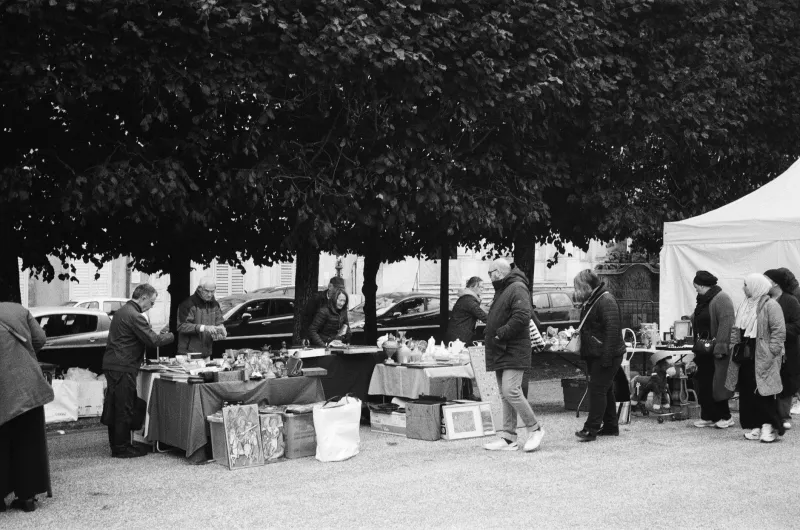
British queuing etiquette reaches one of its purest forms beside a temporary stall outside a phone shop. There is no sign saying where the queue begins. There is no need. A woman in a fleece will ask 'Is this the queue?' although it obviously is. A man will join the back and then ask the same question ten minutes later. The queue is not really for the drink. It is for reassurance.
The best switch-ons have a chip van, a church kitchen selling mince pies from a trestle table, and a raffle with prizes you could win at any point in the last forty years. Bring coins. Bring layers. Stand near the choir rather than the speaker, unless you enjoy hearing the same announcement about parking restrictions four times.
Volunteer Stamina and the Real Budget
The real budget is measured in extension leads and goodwill. Somewhere behind the tree is a person with a clipboard and a risk assessment, checking that the scaffold tower is stable and that the generator is not going to be tripped over by a toddler. That person is the star of the show. They will not be mentioned in the programme. They will be there at 7am the next morning, taking it all down.
This winter, 2026, the pressures are familiar: tight council budgets, insurance costs, fewer volunteers, more forms. And yet the switch-on persists. It persists because it is one of the few moments when a high street becomes a room. People who ignore each other all year stand shoulder to shoulder and look upwards. That is not nothing.
How to Choose Your Switch-On
If you have a choice of municipal festive events this December, here is my field guide.
Seek out the smaller town square with the community choir and the handmade lanterns. Look for the event where the running order is slightly uncertain and the compare for the evening is a councillor who clearly did not volunteer for the job. Look for a real tree, a brass band, and a mince pie made by someone's aunt.
Be wary of the switch-on sponsored by a phone network where the lights are synchronised to a pop song and the celebrity is a reality television contestant in a branded coat. It will be louder, smoother and somehow less convincing. The better event has a raffle, a puddle, and at least one bulb that refuses to cooperate.
The Moment Before the Lights
There is a pause just before the switch. The tannoy crackles. A child on shoulders points at the tree. The choir takes a breath. Everyone looks up. Then the lights come on, slightly lopsided, and the square applauds itself.
That is municipal hope: the belief that next year will be a bit better, the extension lead will reach, and the star will be fully lit. It rarely is. But the countdown from seven still works, and the queue still forms, and the padded coat still appears. Go and stand near the back. Buy a mince pie. Count down from seven. It will not fix the high street, but it will remind you that the high street can still be a room.