Four Laminates and a Fried Egg: The Quiet Power of the Café That Does One Thing
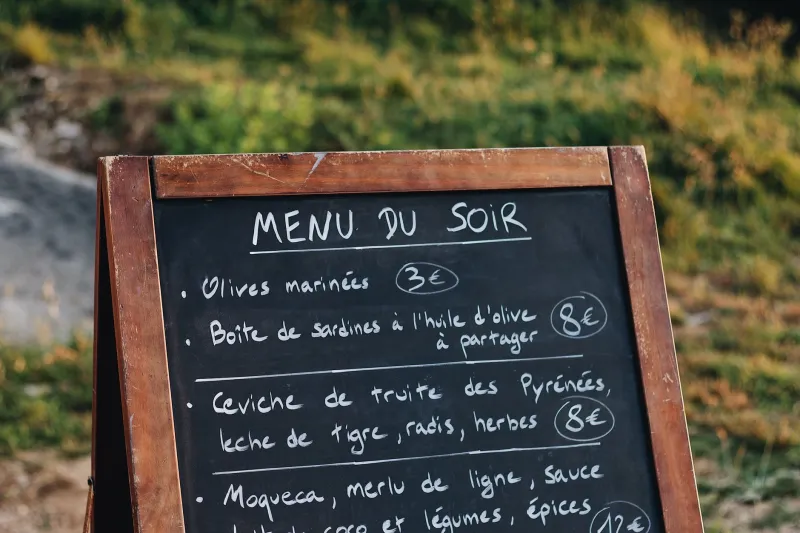
Somewhere in your town, probably between a charity shop and a estate agent, there is a café with a laminated specials board. It has been laminated for so long that the laminate has started to curl at the corners. There is a handwritten correction in marker pen. There is a strip of Sellotape holding down a price that has changed twice since the board was printed. And there are, if you are lucky, four things on it. Not forty. Four.
In 2026, when every chain seems to offer a seasonal menu that reads like a focus group's dream journal, this is not a lack of ambition. It is a kind of confidence. The café that does one thing perfectly is telling you something important: we know what we are, and we know what you are here for.
The Board Is the Menu's Honest Face
A glossy menu hides its compromises in design. A laminated specials board cannot. The marker pen correction is a public admission that the price of cheese has gone up, that the supplier has let them down, that the soup has changed because the courgettes were cheap. It is a small document of local economics, sellotaped to a wall.
You can learn a lot from how a café treats its board. If the board is clean, typed, and mysteriously free of corrections, you are probably in a place that has a head office. If the board is a palimpsest of stickers and crossings-out, you are probably in a place where the person cooking your lunch also decided what to put on the board that morning. Both can be fine. Only one is interesting.
The best boards have a hierarchy. The thing they do perfectly is at the top, usually in bigger letters. Everything else is a supporting act: a few sandwiches, a jacket potato, perhaps a slice of cake that was made by someone's aunt. The board is not trying to impress you with range. It is trying to direct your attention. That is a generous act.
Why Short Beats Long
There is a widespread assumption that a short menu means a lazy kitchen. In my experience, it usually means the opposite. A café that offers one excellent thing has made a decision about where to spend its effort. It has bought better ingredients for that one thing. It has practised it. It has resisted the urge to add a panini just because a panini might sell.
This matters more in 2026 than it used to. Rents are grim, energy bills are still a punchline, and every café owner I have spoken to is doing arithmetic in their head while they take your order. A long menu in a small kitchen is a recipe for waste, freezer burn and the quiet sadness of a chalkboard that promises too much. A short menu is thrift with a bit of pride attached.
And there is a local identity question here too. The café that does one thing perfectly becomes a landmark. People say 'the one with the good bacon sandwich' or 'the place with the cheese and onion pie'. That is not a small thing. It is how a town builds a mental map of itself. Chains give you consistency. A short menu gives you a place.
How to Read a Laminated Specials Board
First, look at the corrections. A board with no corrections at all is suspicious. A board with too many is a warning. You want two or three, ideally in different pens, suggesting a history rather than a crisis.
Second, look at the language. 'Homemade' is doing a lot of work in British café culture and it is not always true. But 'our own' or 'made here' is usually a better sign. So is a specific detail: 'Mrs Patel's chutney', 'the good sausages from the butcher on the corner'. Specificity is the friend of the honest café.
Third, look at what is missing. If there is no avocado, no sourdough, and no option to add halloumi, you may have found somewhere that has not been visited by a brand consultant. That is not a guarantee of quality, but it is a useful signal.
Fourth, look at the font. If the board uses Comic Sans, you are probably in for a decent fry-up. If it uses a typeface that has been carefully chosen to look handmade, you are probably about to pay £9.50 for a mushroom.
What to Order, and How to Behave
Order the thing at the top. The board is not subtle. The thing at the top is what the kitchen believes in. If it is a pie, have the pie. If it is a breakfast, have the breakfast. If it is a sandwich, do not ask for it on gluten-free bread unless that is also on the board; you are not being difficult, but you are asking a small kitchen to improvise, and improvisation is how the good thing stops being good.
Do not ask for a substitution that requires a separate pan. Do not ask if the soup is vegan unless you can see the soup. Do not photograph the board for so long that the queue behind you starts to question its life choices. This is not a museum. It is lunch.
And if the person behind the counter tells you the thing at the top has sold out, accept it. That is the short menu working as intended. It means the thing was good, and other people knew it. Have the second thing. The second thing is usually a jacket potato, and a jacket potato made by someone who has just sold out of their signature dish is still a fine lunch.
A Recommendation, Not a Nostalgia Trip
I am not arguing that every café should strip its menu to four items and start hand-writing corrections on a laminate. I am arguing that we should notice the ones that do. They are a quiet reminder that taste is not the same as choice, that thrift is not the same as meanness, and that a town's character is often held together by Sellotape and a marker pen.
So next time you see a laminated board with a curled corner and a price crossed out twice, go in. Order the thing at the top. Sit by the window. Watch the town go past. You will learn more about where you live than you would from any restaurant review with a star rating and a photograph of a foam.
The board knows what it is. That is rarer than it sounds.