The Corkboard Canon: Reading a Town Through Its Staples and Sellotape
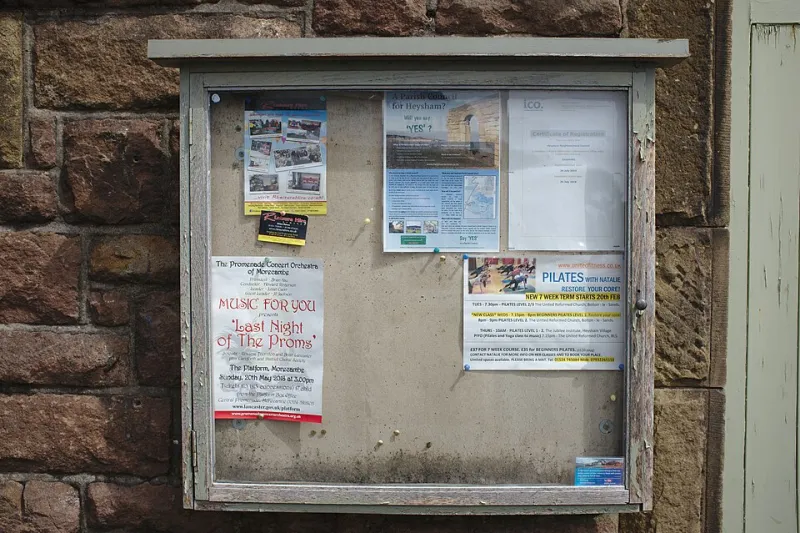
Photo: Bob Harvey , CC BY-SA 2.0, via Wikimedia Commons
There is a certain kind of British afternoon that begins with a damp leaflet and ends with a small, unreasonable sense of hope. You are walking past the church hall, or the Co-op, or the bus shelter that has been repurposed as a shrine to parish notices, and a sheet of A4 flutters under a drawing pin. It says JUMBLE SALE in three fonts and gives a date that has already passed. You read it anyway. That, I think, is the beginning of an argument.
The parish noticeboard is not a quaint relic. It is an editing job. It is the last place in Britain where a piece of paper can be pinned up by anyone with a spare thumbtack and a grievance, and where the result is read by people who have no choice but to walk past it. In 2026, when so much local news arrives as a press release with a photo of a cheque, the board remains stubbornly, usefully human.
The board is an edit, not a dump
Every noticeboard is the result of a hundred tiny decisions. The editor is the person with the staple gun. The sub-editor is the weather. The advertising department is the woman from the WI who needs to shift fifty raffle tickets before Friday. There is no editorial meeting, no style guide, no comments section. There is just a finite surface area and a shared understanding that last month's quiz night has to come down before this month's coffee morning can go up.
That scarcity matters. A Facebook group can hold infinite posts, which is why it fills up with arguments about wheelie bins and photographs of sunsets. A noticeboard cannot. It has a front page at eye level and a back page below the coat hooks. It has a top layer of fresh Sellotape and a bottom layer of curling, sun-bleached history. The best boards are palimpsests: you can see the ghost of a lost cat under a notice about a planning application, and the ghost of a summer fete under both.
A field guide to the notices worth stopping for in 2026
The handwritten lost cat appeal. This is the board's short story. It has a photocopied photograph, a mobile number with one digit crossed out, and the phrase no questions asked. The cat is called Biscuit. The cat is always called Biscuit. You do not know the owner, but for the rest of the day you are slightly worried about Biscuit.
The jumble sale flyer. Three fonts, one typo, a tear-off strip that has been torn off. The words bacon butties are doing more persuasive work than any council communications team could manage. You do not intend to go. You go.
The parish council agenda. A planning application for a rear extension. A footpath diversion. A note about dog bins. This is local democracy in its raw state, with no spokesperson and no press officer. Read it and you know what your neighbours are actually arguing about. It is more informative than most council press releases because it has not been smoothed into a message.
The passive-aggressive public notice. Would the person who leaves black bags beside the dog bin please note that this is not a household waste facility. It is a genre. It is also a form of social contract, written in biro and pinned at slightly the wrong angle.
The coffee morning, quiz night or craft circle. Two pounds fifty, includes cake. These are the social infrastructure. The board is where loneliness gets a time and a postcode. It is also where you learn that the mobile library comes on Thursdays and that the defibrillator is in the old phone box.
The strange one. For sale: vintage mangle, buyer collects. Lost: hearing aid, possibly in the recreation ground. Free: piano, needs tuning, no time wasters. These are the board's poetry. They are also a reminder that a town is not just a set of services. It is a collection of objects and people trying to get rid of each other's stuff.
Why it beats the local paper
I am not going to pretend that the noticeboard is a comprehensive news source. It is not. It will not tell you why the bus route changed or what happened at the full council meeting. But it will tell you what people are worried about, and it will do so without a media strategy.
Local papers are not what they were. Many are owned by groups, filled with syndicated copy, and reliant on advertising. The noticeboard has no ad manager. It cannot be bought by a sponsored post. It is slow and physical and accountable: if you lie on a noticeboard, someone will recognise your handwriting. It is incomplete, which is the point. A newspaper pretends to be complete. A noticeboard admits it is a snapshot.
That is why it is a more honest local newspaper than most actual newspapers. It has no choice but to be local. It cannot fill space with a story about a celebrity who once visited a shopping centre in another county. It cannot run a headline designed to make you angry enough to click. It just pins up what someone thought was worth knowing.
How to read one properly
Stand for ninety seconds. Read the top layer, then the curling bottom layer. Check the dates. Note what has been removed. Look at the handwriting. Ask what is missing: no notices for the food bank, no mention of the library closure, no posters for the youth club. The board is a conversation with gaps.
Do not photograph it for content. Just read it. The board is not a brand. It is a place. You are allowed to stand there in the drizzle and take it in without turning it into a post.
The last great editing job
The internet gave everyone a noticeboard and then ruined it with comments. The parish board still has a finite surface area. That scarcity forces choices. It is edited by everyone and no one, and it is better for it. Next time you pass one, stop. You are reading the mood of a place in staples and Sellotape. It is the cheapest local newspaper in Britain, and the only one that never asks you to accept cookies.