Closed for Cleaning: How to Read a Town Through Its Public Loo
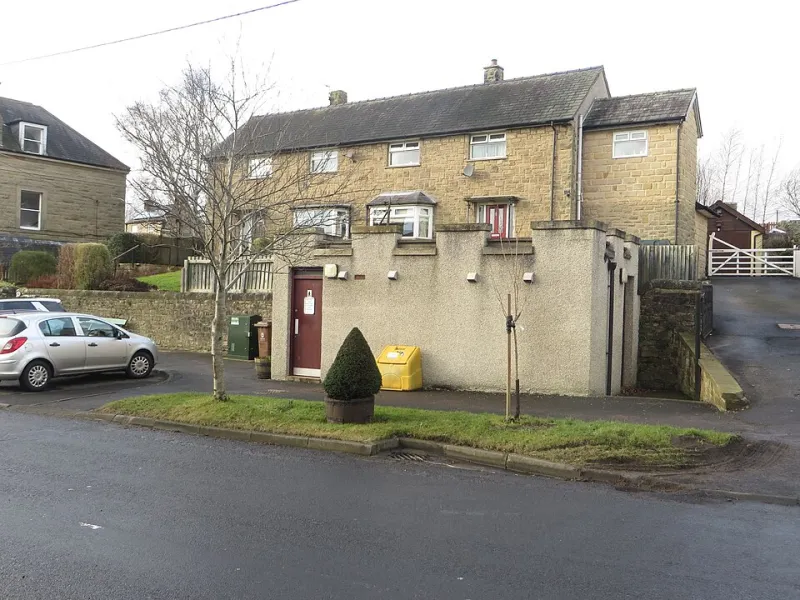
Photo: Graham Robson , CC BY-SA 2.0, via Wikimedia Commons
There are two kinds of British town, and you can tell them apart in under a minute. Stand in the middle of the high street, look for the little pictogram of a person with a sensible stride, and follow it. Whatever you find at the end of that walk is the town's honest opinion of itself, written on a wall.
I've been doing this for years now, quietly, in car parks and bus stations and the far corner of recreation grounds. It is a harmless hobby and it has never once let me down. Public toilets are the one bit of local infrastructure a council can close without anybody arranging a campaign, which is exactly why the ones still standing are worth a second look.
The turnstile that outlived the coin
There's a certain generation of turnstile — heavy chrome, a slot that once demanded tuppence — now carrying a laminated A4 sheet: CARD ONLY. Or FREE ENTRY, PLEASE DONATE, with a Tupperware tub cable-tied to the rail. The tub is always about a third full of coppers and one rogue euro. That tub is a town's entire fundraising strategy in miniature.
I like the tub towns. Tub towns are trying. Someone there has argued in a meeting that the place is worth keeping, and lost the argument about the budget, and gone out and bought a tub anyway.
Then there's the other sort of town, where the doors are stainless steel, the floor is that grey non-slip material, and there is a speaker on the wall quietly playing birdsong. Someone sat in a room and proposed the birdsong. I would like to shake that person's hand.
Reading the laminated apology
Every public convenience has a notice, and it is the closest thing Britain has to a public register of official apology. The great ones fall into recognisable orders.
- The optimist: "Back at 10.15." No date. No year. Possibly no return.
- The realist: "Closed for cleaning."
- The bureaucrat: a full A4, in Comic Sans, explaining that the facility has been temporarily withdrawn following a "vandalism incident" and that the nearest alternative is in the next county.
- The theologian: "No loo roll. Sorry."
- The grand romantic: "Closed until further notice. Thank you for your understanding." There is never any understanding.
The finest sign I ever saw, in a market town I'll spare the embarrassment of naming, read: CLOSED FOR CLEANING — BACK IN 15 MINUTES. The lamination had gone yellow. The tape had gone brown. A man walking a whippet told me the cleaner had retired in the spring.
The hatch is the last customer service desk in Britain
If you're lucky, your town still has an attendant: someone in a fleece behind a hatch, armed with a mop, a radio, and an encyclopaedic knowledge of the bus timetable. This is unfiltered civic life. You can get directions, a plaster, a verdict on the weather and a piece of information about a relative you didn't know you were related to. You cannot get that in a bank anymore, because the bank has gone and the cash machine has been replaced by a barber's shop.
Attendants also know, with total authority, what the town is currently worried about. It is usually parking.
The bin bag over the hand dryer
We should talk about the bin bag, because it is the most honest document in local government. A black sack taped over a hand dryer is an admission: we have run out of the specific energy required to fix this, but we have not yet given up on you drying your hands on your trousers. Maintenance by shame. It is a very British form of care.
Same with the missing hook on the back of the door. The hook is the cheapest amenity known to humankind and its absence tells a procurement story no freedom-of-information request could improve on. A working hook, a working lock, a mirror at the right height and a bin that actually gets emptied — that's the checklist. A town that gets the hook right tends to get other things right as well, and I will not be talked out of this.
The unofficial network
Since we're being honest: the real public toilet network in 2026 is the burger place, the coffee chain, the library, the big supermarket and any pub that hasn't yet put up the sign about customers only. We all know the etiquette. Buy something small, be brisk, don't ask questions. It works. But it is a privatised kindness, available to people who can afford a flat white and are comfortable walking past a certain amount of silent judgment.
Community toilet schemes, where councils pay cafés a modest retainer to open their doors to all comers, are a good, cheap, sensible idea and I am entirely in favour of them — and they are still not the same thing. A public toilet is the one indoor place in town where you don't have to buy anything to be allowed in. That isn't a small detail. That is arguably the whole meaning of the word public.
Add in the RADAR key, the Changing Places facility, the parent-and-baby, and the accessible cubicle quietly used as a storage cupboard since the last reorganisation, and you have a fairly exact measure of who the town has decided counts.
What a good one looks like
I'll finish with a defence, because this is an opinion column and I have earned one.
A decent public convenience is not a luxury and it is not a relic. It is what gets a pensioner out of the house on a Tuesday. It keeps a bus pass worth having. It makes a market day possible for someone with a bladder condition, or a toddler, or a long walk home. It is the reason a day out doesn't have to end at two o'clock.
And it doesn't cost the earth. It costs a hook, a bag, a tub of coppers and one person in a fleece who genuinely cares. The towns that still have all four — the ones with the birdsong and the working lock and the attendant who knows your nan — aren't being nostalgic. They're just paying attention.
So next time you see CLOSED FOR CLEANING, don't tut. Look at the date on it. Look at the state of the tape. That's your town, written down in biro, for anyone who bothers to read it.