Mind the Grate: A Field Guide to the Ironwork Beneath Your Feet
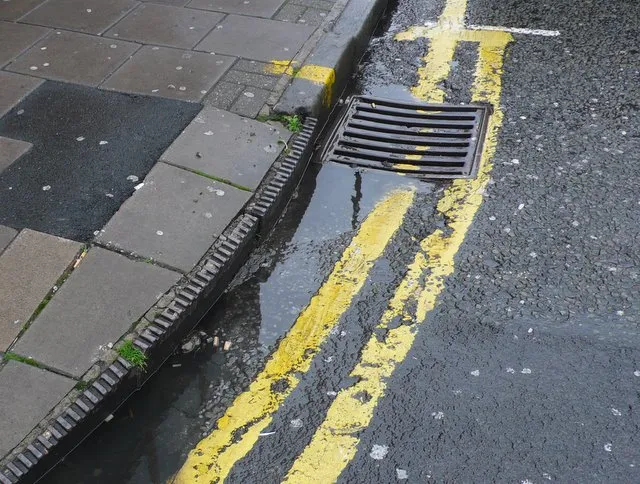
Photo: Nigel Mykura, CC BY-SA 2.0, via Wikimedia Commons
The other morning I stood outside a bakery waiting for a sausage roll and found myself staring at the ground. Not in a despairing way. Just looking. At my feet was a gully cover stamped with a foundry name and a date from the 1950s, its grid pattern softened by decades of boots and tyres. Two metres along, a smaller stop-tap lid had been painted over so many times the lettering looked like a relief map. A few doors down, a bright new composite cover sat slightly proud of the tarmac, innocent of any maker's mark at all.
That's a town, that is. Not the shop fronts, not the hanging baskets. The iron under your feet.
The three-cover test
I'm not going to pretend this needs a clipboard and a hi-vis vest. It doesn't. The easiest way in is what I call the three-cover test: pick a junction, a short shopping parade, or the bit of pavement outside a pub, and look at three covers in a row. One old, one new, one odd. That's enough to start a conversation with the place.
The old one tells you who made it and roughly when. The new one tells you who maintains it now, or whether anyone does. The odd one — a lid from another town, a concrete infill, a cover welded so crudely it looks like a scar — tells you about budgets, improvisation and the general weather of local decision-making. You can learn more from that trio than from most council leaflets.
Foundry names are a map of industrial Britain
Once you start noticing, the names become a roll call of British engineering: Stanton, Dudley, Needham, Blakeborough, and a dozen others I'm still learning. Some of these firms supplied half the country's utilities at their peak. Their covers are scattered from Cornwall to Caithness, often in towns where the company never had a works. That's the point. Cast iron travelled.
A cover stamped with a Scottish or Midlands foundry, sitting outside a chip shop in a southern market town, is a small piece of supply-chain history. It also reminds you that the utilities were once a patchwork of private companies, municipal engineers and regional gas boards, each with its own purchasing habits. In 2026, most of us don't think about who owns the pipes. The iron remembers.
Read the stencil, not just the iron
The metal is only half the story. Look at what's painted on it. FOUL. SURFACE. WATER. BT. GAS. Sometimes a contractor's initials, a phone number, a squiggle of yellow or blue. These stencils are the town's handwriting — hurried, practical, occasionally charming in their lack of care. A stencil that's been overpainted three times tells you the cover has been repainted by different hands, maybe on different maintenance cycles.
And the colours matter. A faded blue lid near a kerb might once have marked a water valve; a yellow one nearby could be gas. If the paint has worn off entirely, that's a finding too. It suggests nobody has looked at it in years.
The honesty of a welded repair
My favourite covers are the repaired ones. A corner welded back on. A crack stitched with a metal plate. A lid that doesn't quite fit its frame, sitting like a bad filling in a tooth. These are not failures of civic pride. They're evidence of it, in a way. Someone decided the cover was worth fixing rather than replacing. That's a small budget decision made by a real person on a wet Tuesday.
A perfectly flush cover often means the road was resurfaced recently. A sunken one means the tarmac has settled, or the frame was never set right, or heavy lorries have been using a street that wasn't built for them. The kerb tells you about traffic. The lid tells you about maintenance. Together they're a fairly honest audit of how a place is doing.
A practical route for the curious
Pick 200 metres of pavement. Start at the war memorial, the bank, or the bus stop and walk to the charity shop. Loop back on the other side. That's your survey area. Don't lift anything. Don't kneel in the road. Wear something visible if it's dusk, and keep one eye on the traffic. This is a pavement sport, not an extreme one.
Note five things for each cover you like: the maker, any date, the type (gully, inspection, stop tap, hydrant), the condition (flush, sunken, welded, painted), and the stencil. A phone photo does the job. If you want to compare notes with a friend in another town, even better. The differences are usually more interesting than the similarities.
New housing estates are worth a look too. Many have identical composite lids with no maker's mark at all. That's not a failure of the exercise. It's a result. It tells you the town's newest streets were built on standardised infrastructure, installed quickly and designed to be forgotten.
What the iron adds up to
I'm not arguing that drain covers are beautiful. Some are, but that's not the point. The point is that they are uncurated. Nobody has arranged them for your enjoyment. They are the town's paperwork left out in the rain — foundry marks, dates, stencils and repairs, all pretending to be invisible.
So next time you're waiting for a bus, look down. You might find a date older than your house. You might find a foundry name that closed before you were born. You might find a lid that has been quietly doing its job since the year of the Coronation. That's not nostalgia. That's just the town, talking to itself in cast iron.